
Poetry and Songs of China's Grasslands
Spatiotemporal Model of Humans and Land
On the afternoon of 7/16, the 9th-floor space of Chang'an Club was filled with the scent of wine and the sound of music. Veteran member Teacher Ma Zhun arrived with stories from the grasslands. Over two hours, his sharing transported everyone through the quivering notes of "Crossing the Great Wall," guided them home along the melody of "Father's Grassland, Mother's River," and finally, in the throat singing of "Mongolians," let them feel the most passionate bond between people and the land.

From the Hu Line to Yurt Smoke: Decoding the Grassland at Three Scales
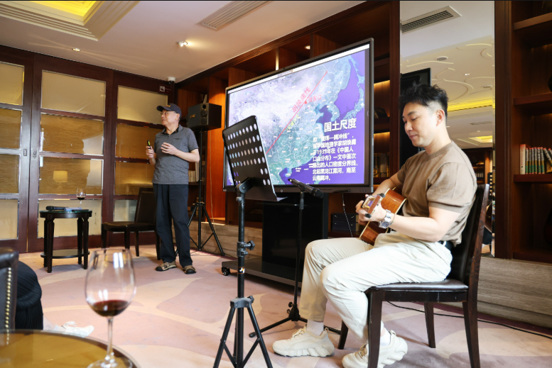
Professor Ma's presentation unfolded like a slowly unrolling scroll. He began with the Hu Huanyong Line as his thread, tracing the journey from Shenzhen's fishing village to the Yin Ruins of Anyang. Using time markers of 50 years, 500 years, and 3000 years, he measured the trajectory of civilization's migration across China. When discussing how this line overlaps with the Great Wall and the 400 mm isohyet, he smiled and asked, "Isn't this the very landscape of borderland poetry?"
Later, Xi Murong's story became the most moving footnote. This Mongolian poet who never set foot on the mainland wrote in "Song of the Frontier Pass" about "the unique fragrance found only beyond the Great Wall"—a scent her father described from grasses picked along German roadsides, and what her mother called "the dry wind of the grasslands." In 89, when she finally stood on the grasslands of Mingant Town and wept, Teacher Ma said, "That single tear holds the homesickness of an entire nation."
What hit hardest was his memory of first seeing the grasslands at 27—packed into a camel wagon full of 20 people, frowning from the pungent smell of Mongolian strong liquor, then turning to tears at the sight of wildflowers blooming across the hills. Later, helping herders build sheep pens in East Ujimqin Banner and singing "Mongol People" in both Mongolian and Chinese with Batel, I realized what he meant when he said, "Everyone has a grassland in their heart"—the moment he hugged me and cried.
Strings and Long Song: Returning to Your Roots Through Live Resonance
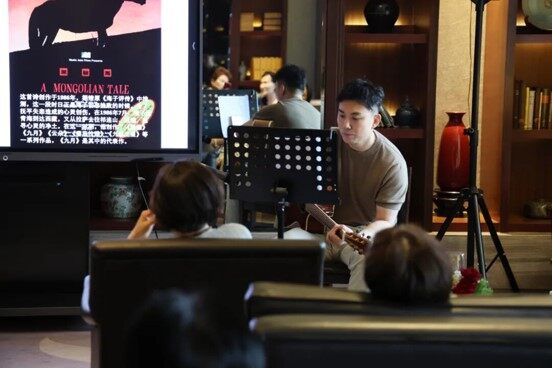
The event space transformed into a moving grassland. As young musician [Shi Yi] strummed his guitar, Teacher Ma began singing an adaptation of "Wings of Song." The moment he sang the line "Go to the vast grasslands," it felt as if the wind from Xilin Gol had blown right into the room.
When singing "Father's Grassland, Mother's River," he paused deliberately: "Teacher Dedema had just recovered from a stroke. Seeing her gritting her teeth to revise the melody on the piano was more moving than the lyrics." Then, as the throat singing of "Eleven" began, its deep, resonant tones wove together with the melody of "Mongol People." Someone whispered, "It sounds like the smoke from a yurt hearth is speaking."

After a few rounds of drinks, Teacher Ma pulled out old photos—the duet with Liu Shikun from 1975, the "Gramophone for 40 Years" poster from the subway. "The boy who once sang 'Sour Jujube Thorns' has now become an uncle chasing the grasslands." Someone in the audience replied, "Aren't we all just searching for a spiritual pasture within this steel forest?"
The Digital Steppe: Our Covenant with the Land
At the end of the sharing, Teacher Ma sighed softly while pointing to a map of the Hu Line: "Ancient people measured the land with horse hooves; now we explore the world with our phones. But no matter how smart AI is, can it calculate the scent of the grassland?" He spoke of herder Burin Bayar's family, who own a pickup truck yet insist on raising horses. "That isn't stubbornness—it's an ancient promise made with the land."
As we were leaving, someone raised a glass and said, "Next time in the grasslands, let's take Haidi's poetry—'A lone rider gallops across the steppe.' So free-spirited." Teacher Ma smiled and replied, "Better yet, let's meet at the Horse Racing Festival. Let the throat singing of [11] wake up the wildflowers covering the hillsides."
This sharing is ultimately about "coming home." No matter how far we go, the fragrant breeze beyond the Great Wall, the smoke from yurts, and the tremolo of the Morin Khuur will always be our gentlest bond with the land.
Explore more events