
One coat, one blade: centuries hidden within. The beauty of lacquerware blooms in Chang'an.
Chang'an Intangible Cultural Heritage Event: Master Class on Lacquer Carving – Highlights
As the faint sound of lacquerware carving tools touching the lacquer layer echoed through the 9 floor of the Chang'an Club, and fingertips traced the warm texture forged by a thousand years of craftsmanship, a dialogue between intangible cultural heritage and time unfolded gently on the afternoon of 7 17. The Chang'an Intangible Cultural Heritage Society's "Master Lecture Series" invited Mr. Zhu Jiang, representative inheritor of Hebei Province's Intangible Cultural Heritage in lacquerware carving techniques and Beijing Master of Arts and Crafts, to guide members into the magnificent world where lacquer and carving knives intertwine, exploring the theme "Diaoqi: One of the Eight Great Craftsmen of Yanjing." Here, they can touch the warmth of this millennium-old art form.
One Lacquer, Traced Back: From the 8000-Year-Old Lacquered Bow to Contemporary Craftsmanship
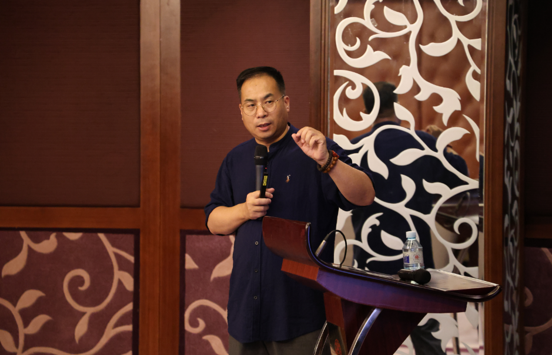
Lacquer is China's oldest plant-based coating. As early as 8000 years ago, lacquered bows unearthed at the Kuahuqiao site in Hangzhou reveal our ancestors' early understanding of this material. Teacher Zhu Jiang began his talk with an artifact: the red lacquer wooden bowl from Hemudu, dating back 7000 years; the Tang Dynasty shift from painted decoration to carving; the legendary craftsmanship of Zhang Cheng and Yang Mao during the Song and Yuan dynasties; and the opulent court workshops of the Ming and Qing eras. Through history, the evolution of carved lacquer has been carefully traced.
He specifically showed an image of a Yuan Dynasty carved lacquer plate from the Palace Museum collection. "Look at these intricate patterns, like detailed paintings," he said. "By the Yuan Dynasty, carved lacquer had evolved from simple cloud motifs into an art form that integrates painting with carving." When mentioning the Ming Dynasty's Guoyuan Factory and the Qing Dynasty's "Lacquer Workshop," he smiled and added, "Qing artisans were renowned for their sharp, precise刀work. They could carve dense, elaborate brocade-like patterns on a single piece—so much so that even Emperor Qianlong couldn't resist getting involved in the design himself."
From the export legacy of Min Guo Ji Gu Zhai to the gold medal won at the 1915 Panama-Pacific International Exposition for the "Group of Immortals Paying Homage" screen; from the peak era of Beijing Lacquerware Factory with its mass production involving 800 workers, to today's dedication by intangible cultural heritage inheritors—Master Zhu Jiang tells the thousand-year story of lacquer carving with the depth of layered varnish and the clarity of a carving knife.
One Blade's Craft: The Secrets of Lacquer and the Structure of Carved Lacquer
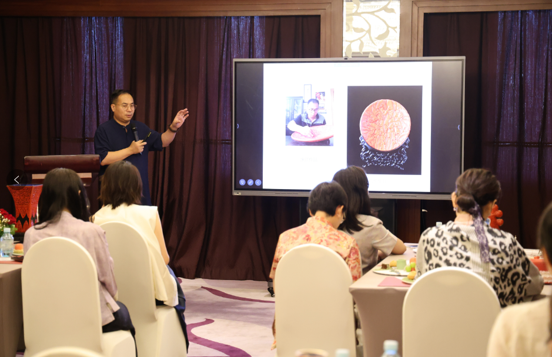
True lacquer carving is a symbiosis of lacquer and carving." Master Zhu Jiang held up a handmade chisel, its blade as sharp as a scalpel. "I ground this tool from steel by hand. Every step of lacquer carving relies on such precision and craftsmanship."
He demonstrated the core material of lacquerware on-site: natural lacquer. "This lacquer is the blood of the lacquer tree, flowing out from V-shaped cuts. Chinese people have used it for thousands of years." He shared its remarkable properties with a smile: acid and alkali resistance ("a drop buried in soil remains intact for millennia"); compatibility with gold, silver, copper, iron, bamboo, wood, ivory, and horn; medicinal use, as recorded in the *Compendium of Materia Medica*; and antioxidant and antibacterial capabilities ("milk stored in a lacquer bowl won't spoil for a week").
The craft of carved lacquer is a true testament to "slow work yields fine results." "You apply 1–2 coats of lacquer daily, building up over 100 layers before carving begins. Just the coating process takes six months to a year," explains Master Zhu Jiang. "First, we score along the outline of the closed design with a knife. Then, we carve away the excess lacquer layers and finally polish it smooth. One mistake ruins the entire piece." He showcased several works: the red-and-black "tixi" mimics rhinoceros horn patterns, while the tri-colored "ticai" shines like woven silk. Members leaned in closely and spotted intricate "jinwen" (embroidery-like) textures in the empty spaces. "This is the rule of carved lacquer—no large blank areas allowed. We fill them with coin motifs or wave patterns, adding beauty to an already beautiful foundation."
One Touch, Full Flavor: From Rubber Stamps to the Living Heritage at Your Fingertips
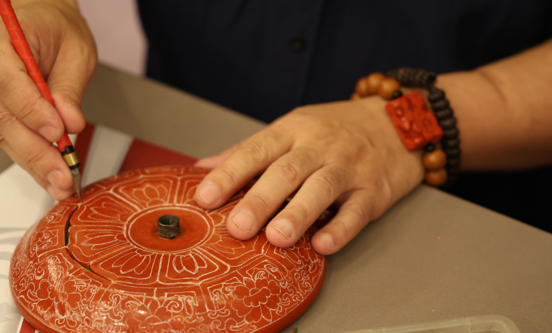
"Words alone aren't enough—let's try carving!" In this interactive session, Teacher Zhu Jiang provided specially prepared rubber blocks and miniature carving tools. "Hold the knife like you would a calligraphy brush: rest your middle finger against the back of the blade and press straight down..." He first demonstrated the "outline tracing" technique on the rubber, guiding the blade along the pre-drawn outline of the character "Fu." "The line must form a closed loop—that's what defines a traditional lacquer carving pattern."
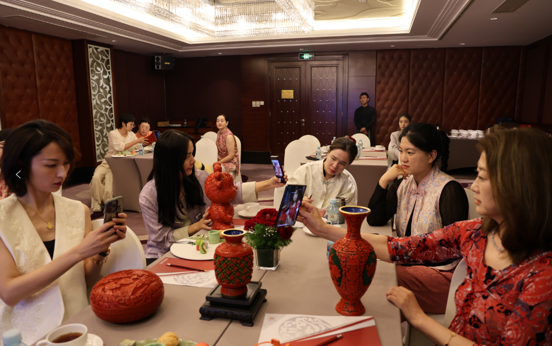
Members eagerly tried their hand at the craft. One participant laughed after making the first cut, saying, "This is more nerve-wracking than surgery!" Master Zhu Jiang offered patient guidance nearby: "Don't worry. Lacquer carving demands a precise first stroke, but even more so, it requires patience. Ancient artisans practiced this fundamental skill for a year on blocks of tofu before ever touching the lacquer layer." As everyone completed their own clumsy yet earnest "rubber carvings," they touched the authentic lacquer pieces on the table with a deeper appreciation for the countless layers of brushwork and precise cuts hidden beneath that smooth surface.
During the session, a member asked, "What are the red-and-black ones called?" Teacher Zhu Jiang took the opportunity to explain: "When red is on the outside, it's called 'Ti Hong'; when black is on the outside, it's 'Ti Xi'; and with three or more colors, it becomes 'Ti Cai'!" Through this Q&A, key knowledge points were shared naturally.
One Craft, Timeless Legacy: Bringing Thousand-Year Traditions to Life Today
At the event's conclusion, Teacher Zhu Jiang showcased his cross-disciplinary works: a master's cup combined with Longquan celadon, lacquer-carved figurines featuring zodiac elements, and a daily-use tea set. "Big lacquer isn't just for display; it can become part of everyday life," he said. "My father has practiced this craft for 40 years, and my master, Grandmaster Yin Xiuyun, for 60 years. Our generation must ensure that lacquer carving upholds tradition while thriving in contemporary spaces."
Members posed for photos with Instructor Zhu Jiang, each holding a freshly completed "rubber carving." Outside, the setting sun bathed the lacquerware display in warm light—red lacquer glowing like amber, black patterns swirling like clouds. This is the power of intangible cultural heritage: it's not just museum artifacts, but living art that can be touched, experienced, and passed down.
Chang'an Intangible Cultural Heritage: Master Lectures is dedicated to bridging heritage with everyday life. Our next session will continue to draw on craftsmanship to explore contemporary expressions of traditional skills. May every encounter bring millennia-old culture back to life in the present day.
Explore more events